Tuesday, 17 February 2015

THIS MONETARY UTOPIA WILL SELF-DESTRUCT


THIS MONETARY UTOPIA WILL SELF-DESTRUCT


http://blogs.wsj.com/economics/2015/02/17/did-shakespeare-make-the-wrong-decision-going-into-liberal-arts-and-not-finance/

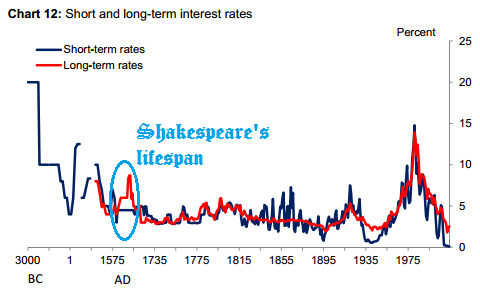
Sometimes you have to listen to what you don’t want to hear. Because if you don’t, it could be the end of the road of your way of life. All is not well in the international monetary system. In fact, the end of this system, as we know it, is now in sight. Just take a look at what happened to global interest rates since 3000 BC! Already, trillions worth of international bonds carry negative yields today. The unthinkable is happening right in front of our eyes. The global monetary system is headed for an historic systemic failure.

Global interest rates are falling into the abyss. It’s harmful enough if savers lose their return on their capital and, with negative rates, are being penalized for having capital at all. But it’s disastrous if creditors can no longer obtain a profit from the spread between short and long rates. Short-term credit will have to become exorbitantly expensive in order to compensate for a potential negative cash flow problem. Most creditors, however, have little capital and are hugely leveraged. For the vast majority, bankruptcy is around the corner.


Lending can no longer be subsidized by ‘riding the yield curve’ as it flattens, when short and long rates converge. The ‘real’ cost of money will rise substantially. This will accelerate credit contraction, as borrowers, who are able to do so, pay down their debt or default, if they are overstretched. If the yield curve then inverts with short rates leaping up above long rates, the stage is set for a complete breakdown of the financial system. The velocity of money, which stands for the frequency with which a unit of money is spent, and which has been declining since 1997 and collapsing since 2007, will pick up speed on the downside, further adding to severe deflationary pressures.

Also, the main investors in longer term bonds, pension funds and insurance companies, will be faced with no return on, and with a relatively abrupt, exhaustion of their capital. They will go bankrupt. The size of the global bond market is at least $ 100 trillion, which is the essential collateral for the extension of credit and for maintaining the derivative market of at least $ 700 trillion. As debt is money, the whole current monetary system could implode and pass into oblivion.

The 2008 credit crisis, which only affected 10% of the total derivatives market, was just like a lightening bolt, flashing through the sky. The following thunder will be the first stage of the great unwinding of the generational Credit Super Cycle and will put an end to all the global asset bubbles, which temporarily resulted from the frantic monetary stimulus of the Central Banks. A global economic depression, much worse than the one during the 1930’s, will occur virtually overnight and looks now absolutely inevitable.

RICK SCHMULL

February 18th, 2015

WESTCLIFF-On-SEA, Essex, U.K.

=

Wednesday, 24 September 2014

SOME TREES GROW TO THE SKY


SOME TREES GROW TO THE SKY


Miracles do happen or so the herd seems to think at various times in history. That’s why groupthink takes over, ‘liquidity’ momentum trades, regardless of value, call the shots and asset bubbles can be blown out of all proportion. Once you’re in such a phase, it feels like it could last forever. Nobody knows how long a ‘buying stampede’ can last, even if it is a rare one, which has already lasted twice as long as the typical one in history. As long as the primary trend is considered to be up, it may have years left to run! Riding the crest of a long wave is the fastest way to lose any perspective of what usually happens next. Every cycle turns eventually, for whatever reason, and it’s suddenly a whole new ball game.

This whole new ball game is devastating for most. Very few dare to stop playing, before disaster strikes. Most prefer to wait around and become sitting ducks. Whenever historic bubbles burst, with ensuing declines of 90% in a relatively short period of time, unthinkable hard times are bound to follow. Those responsible for letting things getting out of hand, because they lacked the guts to put a stop to it, will have left the scene long before the ‘miracle’ turns into a nightmare. The dream of a ‘free lunch’ will again have dissipated.


The intended consequence of overly lax monetary policies, like Zero or even Negative Interest Rates plus Quantitative Easing (QE), is the destruction of savings. A sustainable economic growth model has to be based upon a pool of savings, which has been painstakingly accumulated over time. If it’s increasingly dependent on credit growth, then this growth model cannot survive, without an everexpanding level of credit to pay the interest on previously issued liabilities. Eventually, this model will hit the wall, because sufficient additional credit cannot be created, which is bound to lead to a capital shortage. Hard to believe, when liquidity today seems to be ‘abundant’!

We now live in very dangerous, unstable times, because unsound money and credit are dominating the global capital markets. Policymakers have designed an artificial world to keep the show on the road, as the global economic growth cycle, for a variety of reasons, has experienced a secular slowdown since its peak 14 years ago, in 2000. But the next phase could well consist of global capital markets going into deep freeze, bank holidays, capital controls, some kind of Debt Jubilee and a collapse of world trade. Markets will therefore tend to discount further real deleveraging, extended economic stagnation and a continued declining trend in both inflation and interest rates. This will be the death knell for credit-driven risk assets, like equities, commodities and real estate. Only quality fixed income holdings, particularly of core well-established government bonds, will weather this storm.


Most of the private sector, which lacks the taxing powers of governments, will suffer greatly. That’s why an investment portfolio should emphasize a 60% Bonds/ 40% Stocks split for the next few decades, as the 60 year inflation and interest rate cycle reverses permanently and risk aversion becomes the name of the game. The notion, that yields of long-term Treasuries could rise 4%, leading to a negative total return of 40% ( but zero loss if held till maturity!), will have to be abandoned. If that ever happened, it would be extremely short-lived anyway, because this heavily indebted world, as a percentage of GDP, cannot afford higher interest rates. Anybody, who believes in the ‘normalization’ of interest and growth rates, obviously refuses to accept, that the world has changed and that ‘the cult of the equity’ since the 1950’s and the 1960’s is over. Needless to say, that expensive, illiquid alternative investments should be eliminated altogether, before it is too late.


RICK SCHMULL


25th September, 2014

WESTCLIFF-On-SEA, Essex, U.K.


=

Thursday, 4 September 2014

THE BEST OF TIMES, THE WORST OF TIMES


THE BEST OF TIMES, THE WORST OF TIMES


It was the best of times, it was the worst of times, it was the age of wisdom, it was the age of foolishness, it was the epoch of belief, it was the epoch of incredulity, it was the season of Light, it was the season of Darkness, it was the spring of hope, it was the winter of despair…
Charles Dickens, A Tale of Two Cities


What could go wrong? A U.S. economic recovery with lower bond yields. A dovish Federal Reserve and an ECB, which will be forced to implement ‘large-scale’ Quantitative Easing. An abundance of liquidity as far as the eye can see, which the markets somehow will have to absorb. Ultralow interest payments on debt and strengthened balance sheets. A possible comeback of U.S. capital and consumer spending, extending the economic expansion. Today’s Central Banking schemes bring ever greater riches to those, who courageously overcome their fear and forget everything in history. Aren’t markets hitting ‘new highs’ all the time?

What could possibly go wrong? Won’t all the pieces for a sustained recovery of many more years eventually fall into place? Isn’t this ‘a new era’, after U.S. earnings per share have quadrupled, in real terms, since 1992, after being stuck at zero for 30 years? Will the powerful, secular uptrend in U.S. profit margins simply keep growing? Shouldn’t markets be at current valuations and aren’t they headed for even higher valuations?

Questions, questions! This is a ‘false’ economic recovery. Nothing is what it seems. Never in history, has there been such a concerted effort to distort and cover up the truth about the ‘real’ economy. Any meltup, as the world supposedly has found the key to permanent prosperity, will be followed by a meltdown. But during these exciting times, when nothing can go wrong and everything has a backstop and therefore remains under control, the sheep could be seduced to finally behave like animals and take more risk. Once the sheep switch from bonds to stocks, run up their credit card debt and embark on another spending spree, then the world is on track to ‘normalization’. Traumatic busts have become things of the past. Uhh…?

Alas, what’s too good to be true, usually is. In reality, global economic growth is anemic, or not impressive at all. In the next decade, even the possible annual GDP growth in the U.S. could be half the rate of the last 50 years. The economy hitting ‘escape velocity’ any time soon is wishful thinking. Financial engineering (buybacks of shares via debt financing) and Mergers & Acquisitions (take-overs with or without debt financing) , the main reasons for these buoyant markets, are slowing down. The downtrend in chronic low inflation, bond yields and interest rates is secular and will persist for many years. Most deleveraging from overindebtedness is still ahead of us. The ageing of the global population is accelerating, especially in Europe and the BRIC’s, which will affect consumer spending and investment style (shift to bonds is secular). The financial sector will continue to shrink dramatically (much higher liquididity ratios) and financialization is bound to grow less than the real economy, which is the opposite of the last few decades. Therefore, the world faces the ominous prospect of a ‘lost decade’, a global Japan scenario, especially Europe. Deflation will not be prevented by onorthodox monetary policies, because real wages of the middle class will continue to decline (internet, globalization) and the velocity of money will continue to fall (secular weak demand for credit).


There is NO reason to rejoice about Europe! Government bond yields of the weakest members of the Eurozone have been collapsing, as their stagnant economies are likely to remain so. Political uncertainties are bound to rise dramatically again. Why would markets assume, that the ECB could purchase government bonds, which would result in a politically unacceptable redistribution of risk? The Eurozone is NOT a country. How much risk to the taxpayer would the ECB be willing or able to accept, by buying very risky Asset Backed Securities? Or will this be just another bailout for the European banks? Large-scale quantitative easing (QE) could perpetuate Zombie Banking, because the necessary adjustments for a healthy banking system would be postponed. Markets seem to be overly optimistic about the possible impact of any loose monetary policy.

Liquidity-driven markets are unstable. It’s great, while it lasts, but when the tide goes out, the insane Carry-Trades, based on faulty models, of the overleveraged speculators, will prove to be their undoing. And then the world will be back to square one. Another financial crisis, much bigger than the previous one.


RICK SCHMULL


September 4th, 2014

WESTCLIFF-On-SEA, Essex, U.K.


==

Friday, 22 August 2014

(STRATEGY): A BLOW-OFF TOP AHEAD?


(STRATEGY): A BLOW-OFF TOP AHEAD?

Let us be perfectly clear. Central Banks are supposed to lean against the wind. Responsible Central Banking calls for periodic restraint, when monetary policies are overly expansive, in order to dampen excessive speculation. Unfortunately, their policies have proved powerless in helping an over-indebted economy reach escape velocity in economic growth, while inflation targets remain elusive, as prices are being determined by the global economy as a whole, not by individual Central Banks. There is no doubt, that ‘bad news is good news’ for the markets, if political pressures ‘to do something’ continue to mount and panic sets in. One can just imagine, what could happen, when Central Banks are forced to push hard on the accelerator at this point in time. If a racing car is already speeding, then such a decision would without any doubt SMASH the car at some point. But here we are: the rulers of the world seem to be faced with an absurd choice. ‘Steady, as she goes’ may be the preferred one, but the time to stick to such a strategy is rapidly running out. Courageous leaders, who pursue sensible policies against the odds, are very rare. Ex-FED chief Paul Volcker, who raised the Prime Rate to 21.5% in 1982 and managed to slay the dragon of runaway inflation in the early 1980’s, was one of them. No words can adequately describe his accomplishments, which paved the way for unthinkable global prosperity in the following decades.


Renewed aggressive monetary expansion may be great news for this terribly ‘mature’ Bull Market, giving it another lease of life, possibly of another few years. Financial engineering, like corporate stock buybacks and record mergers & acquisitions, was a perfect setup to lure the unwary public (less than 10% is still aware of this Bull Market) into buying a seriously overvalued stock market. A blow-off top in certain asset classes, like London property, High-Yield, Classic Cars and famous Art, may already have preceded, whatever could happen elsewhere. But this would be the most serious negative development for global markets and economies in the long run. An unbelievable CRASH would follow, which would put the 1929-event in the shade. Very hard times would come next. The current generation in the developed countries has no idea of the steep price, which had to be paid by previous generations as a result of similar insane actions of the powers that be, in the past.

The pressure on the European Central Bank (ECB) to embark on massive Quantitative Easing (QE), has now become relentless. Words like ‘whatever it takes’ may now have to be translated into action. The markets have been ‘frontrunning’ such action for years, by moving European bond and stock levels to ludicrous levels. Its many technically bankrupt banks and countries have not been any deterrent, because the ECB supposedly would have no choice but to buy everything in sight and ‘own’ the markets in their entirety. Germany’s opposition would crumble in the face of potential deflation and the Eurozone could then be ‘saved’. But this would not be very different from the destitute looting all the stores. A state of emergency, a bank holiday and capital controls would certainly not be far behind. It could be a desperate ‘last act’ of an improbable monetary union of mainly penniless countries, who would otherwise have to resort to constant devaluation or default, which was their tradition in the last 100 years.


The last man standing will then be the U.S., with its relative economic independency and self-sufficiency. The U.S. Dollar and the U.S. stock markets would shine as never before. That flight to safety would not last either. Because a global SMASHUP is in the works.


RICK SCHMULL
August 22nd, 2014

WESTCLIFF-On-SEA, Essex, U.K

=

Wednesday, 13 August 2014

HOARDING CASH IS NEXT


HOARDING CASH IS NEXT

Cash is King, when times are tough. Times are about to become much tougher, as the Eurozone economy is in flames, China’s credit growth has collapsed, Japan’s economy has been hit severely by a sales tax (both imports and exports have crashed!) and the U.S. economy experiences just anemic growth. This bleak global economic outlook (with China already exporting deflation, due to the RMB devaluation) as well as growing geo-political uncertainties are bound to increase the personal savings rate, as a percentage of disposable income, despite ultra-low interest rates. The U.S. savings rate has steadily climbed from 0.80% to 5.30% in the last decade, but before 1985 it was twice the current level. Corporate cash accumulation is likely to accelerate, as confidence in prospects for long-term investment projects has dimmed. Contrary to the expectations of most experts, U.S. Treasury and German Bund yields are now in a freefall, as a result. The Euro Overnight Index Average (EONIA), the benchmark for the Eurozone’s borrowing costs, has reached a record low ever, since the Euro had been created. Everything points to economic stagnation, just one shock away from official recession.


Animal spirits and fears of inflation are making way for defensiveness and conservatism. Fact is, that all markets have not reflected the true state of the economy for some time. As Central Banks intervened and complex algorithm trading systems took over, all markets have been cloaked in secrecy and resemble one large dark pool, where orders have been masked from the public market. Markets have become a con game. This will end badly. Markets may soon appear frozen, with little liquidity, where many sellers will find few buyers. This is another reason to expect, why cash hoarding will skyrocket.


The U.S. Treasury and German Bund markets are now experiencing a serious FLIGHT TO SAFETY. Is this because markets are indeed rigged? How do you ‘fleece’ the dumb tourists in a poker game? You get a few card sharks, who do their thing in order to make it look like a good game’s going on. Are the high frequency traders any different? Is it surprising, that markets are being abandoned by the ‘smart money? Right, the smart money is buying the HIGHEST QUALITY PAPER, before this ship goes down.


RICK SCHMULL
August 13th, 2014

WESTCLIFF-On-SEA, Essex, U.K.

=

Monday, 11 August 2014

MOTHER NATURE IS A DEBT DESTROYER


MOTHER NATURE IS A DEBT DESTROYER


In the last decade, debt has entered into its parabolic phase. Since the financial crisis in 2008, global debt exploded 40% to $ 100 trillion and to a quadrillion dollars worth of derivatives, excluding another $ 100 trillion of unfunded liabilities. Total debt as a percentage of the global economy is now at historical peaks. This would have been thought impossible, just a decade ago. This process will continue, until the system breaks. Mankind has always gone through boom/bust cycles, just like civilizations, planets, animals and enterprises. Typically, these last as long as the average lifespan. The ultimate bust or debt destruction phase is imminent, between now and another few years. Now is the time to prepare and take action, because the inevitable fallout will seriously impoverish the entire world.

The final phase of the current cycle is characterized by ‘one for the road’, one final drink, before the party ends, made possible by ultra-low interest rates of your friendly Central Banker. As soon as markets bring this party to an end, when confidence in the system evaporates, what will follow next, is anybody’s guess. The world eventually will be forced into another monetary arrangement and start again. As debt is considered an ‘asset’ (!), debt destruction will lead to a large-scale wipe-out of global assets. Cash will be King. Banks will again be compelled to call in their loans and outstanding overdrafts. Anything, that is financed, will become ‘toast’. The world experienced a taste of things to come in the Great Financial Crisis of 2008.


Can Central Banks avert this disaster? NO. During their 100-year existence, severe economic contractions have occurred periodically. The last worst financial catastrophe, the Great Depression, when banks closed in 1933, happened anyway. Despite the clear signs of a parabolic debt buildup as a percentage of GDP in the 1920’s, just like today, the sharpest minds in the financial sector did not see it coming. They believed in a ‘new era’, a permanent ‘high plateau’, while it should have been obvious, that the House of Cards was bound to crumble. That’s why each generation tends to make the same mistake and something really ‘bad’ takes place every 80 years or so.


You should know, that you are NOW in the BLOW-OFF TOP. Don’t expect it to look like any previous one, like the dot.com one in 1999, because it won’t. There are scores of long-term indicators flashing ‘red’ already. Merger mania and corporate buybacks have been responsible for most of the expansion in Price/Earnings ratios. Economic growth projections have been slashed sharply across the board and many experts, like the IMF and the Bank of International Settlements (BIS), are up in arms. Revenue increases for the average business, have been hard to come by for years. What if recession and deflation are taking over? THE TRUTH HURTS.


RICK SCHMULL
August 11th, 2014

Sunday, 3 August 2014

THE PARTY'S OVER


THE PARTY’S OVER


I told you so. But it wasn’t what you wanted to hear. You wanted to hear, that the markets and the economy were sound and improving. That the only way for inflation and interest rates would be up. That the financial system, after 5 years, finally emerged from a period of stress. That current market leverage was nothing to worry about. That this current prolonged credit and speculative cycle did not have the characteristics of any dangerous bubble. That Central Banks were not misguided, as they repeatedly intervened in keeping the markets going. That any perceptions of price distortions were way off the mark. But what really happened, was, that the peasants became utterly complacent and unaware of the actual fragility of the system.

So the Boom in risky asset speculation turned into a Bust after all? ‘Modern’ monetary policies would supposedly keep everything under control! There would be ample liquidity at all times. This time, no systematically important institution or country would be allowed to go under in order to avoid a crisis. Lessons were learned from the depression in the 1930’s. So where did it all go so wrong anyway?

The decline started slowly enough, but gained momentum later. As usual, in any mature Bull market, the Small- and Midcap stocks peaked first, followed by the Large Cap Blue Chip stocks. This divergence within the market, was a red light. But then, we were told, the party would simply continue in the top 50 stocks, with their ‘safe’ dividend record, while a higher Price/Earnings ratio would take care of one more dance on the Titanic. We didn’t want to miss that one, did we? A repeat of the Nifty Fifty in the early 1970’s! In the meantime, the yields in the gigantic quality bond market, however, broke down sharply, ‘unexpectedly’, as if economic growth was all a mirage. Wow. This wasn’t supposed to happen. Must have been ‘technical’. The message of that sophisticated market surely was incorrect. Right? Except that those markets were way ahead in discounting the Bust, which was frankly not in the cards. The mathematical models said so!


When you read this, the Bust probably hasn’t happened yet. The markets are experiencing ‘just’ another boring correction, which undoubtedly is seen as another buying opportunity. Buy on the dips has been a winning investment strategy for so long. Mother Central Bank will always act as a backup for you, the speculator, who absolutely needs to continue playing the game in this peculiar Zero Interest Rate world. You cannot imagine anything different! You failed to question, why interest rates and inflation were ‘irrationally’ low. No, forget ‘manipulation’. The reason is, because financial disaster lurks around the corner! The last time such a scenario unfolded, was during the 1930’s. Your portfolio with risky assets is now hanging by a thread and you don’t even know it. The party’s over. Another generation of investors is about to bite the dust.


RICK SCHMULL
August 3rd, 2014

WESTCLIFF-On-SEA, Essex, U.K.

=